
Solution
Print support-free instead of removing supports
Support structures are not a design feature. They are a consequence of uncontrolled heat — and steering heat flow before the build removes most of the need for them.
What supports actually cost
Powder, build time, manual removal and damaged surfaces — and on internal geometries, often the decision not to print a part additively at all. Conventionally, an overhang below roughly 45° is considered unprintable without support.
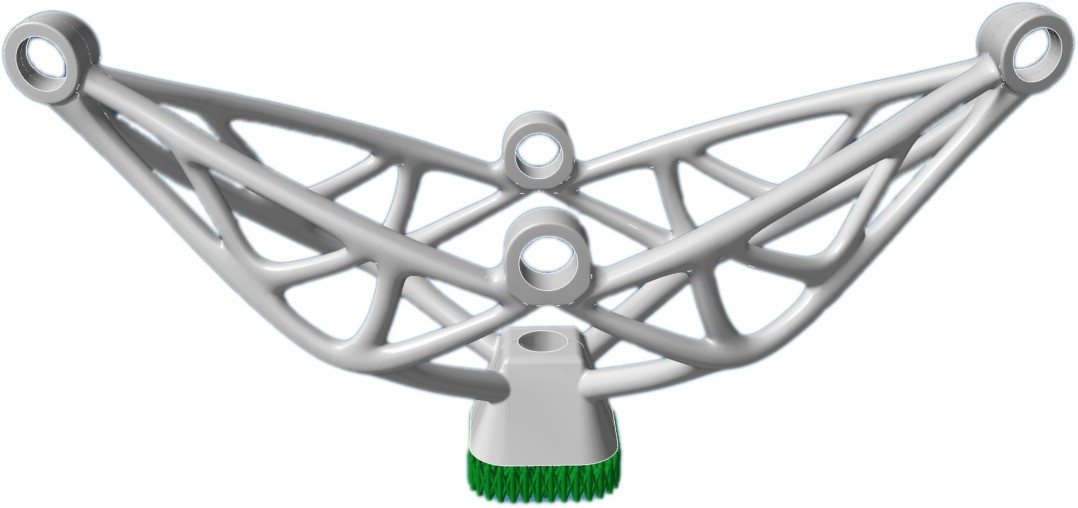
The same part, twice
Drag to remove the supports
Left: prepared conventionally. Right: the same geometry, the same machine and the same material — prepared in GENESIS.
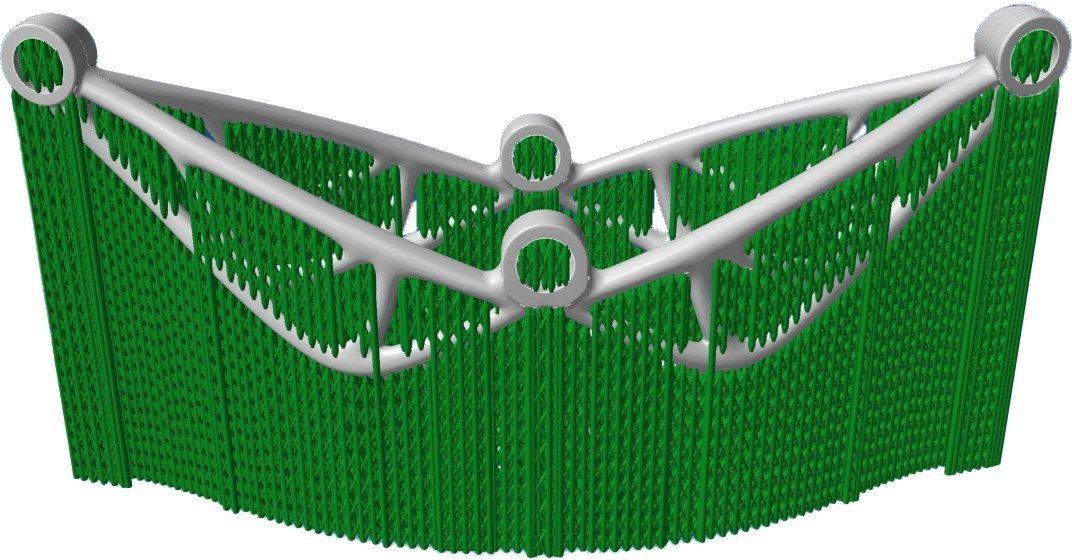
 Standard preparation
GENESIS
Standard preparation
GENESIS
Every support you do not print is powder you do not buy, machine time you do not pay for, and a finishing operation nobody has to do by hand.
How GENESIS solves it
Make the heat visible
Fast Heat Simulation shows where heat accumulates in seconds — intensity and extent, layer by layer.
Adapt the exposure sequence
Smart Hatching changes hatch orientation and sequence locally — for example from the core towards the overhang, and against the shielding-gas flow.
Limit the energy input
Power Control regulates laser power locally, so a thermal peak never forms at the critical spot.
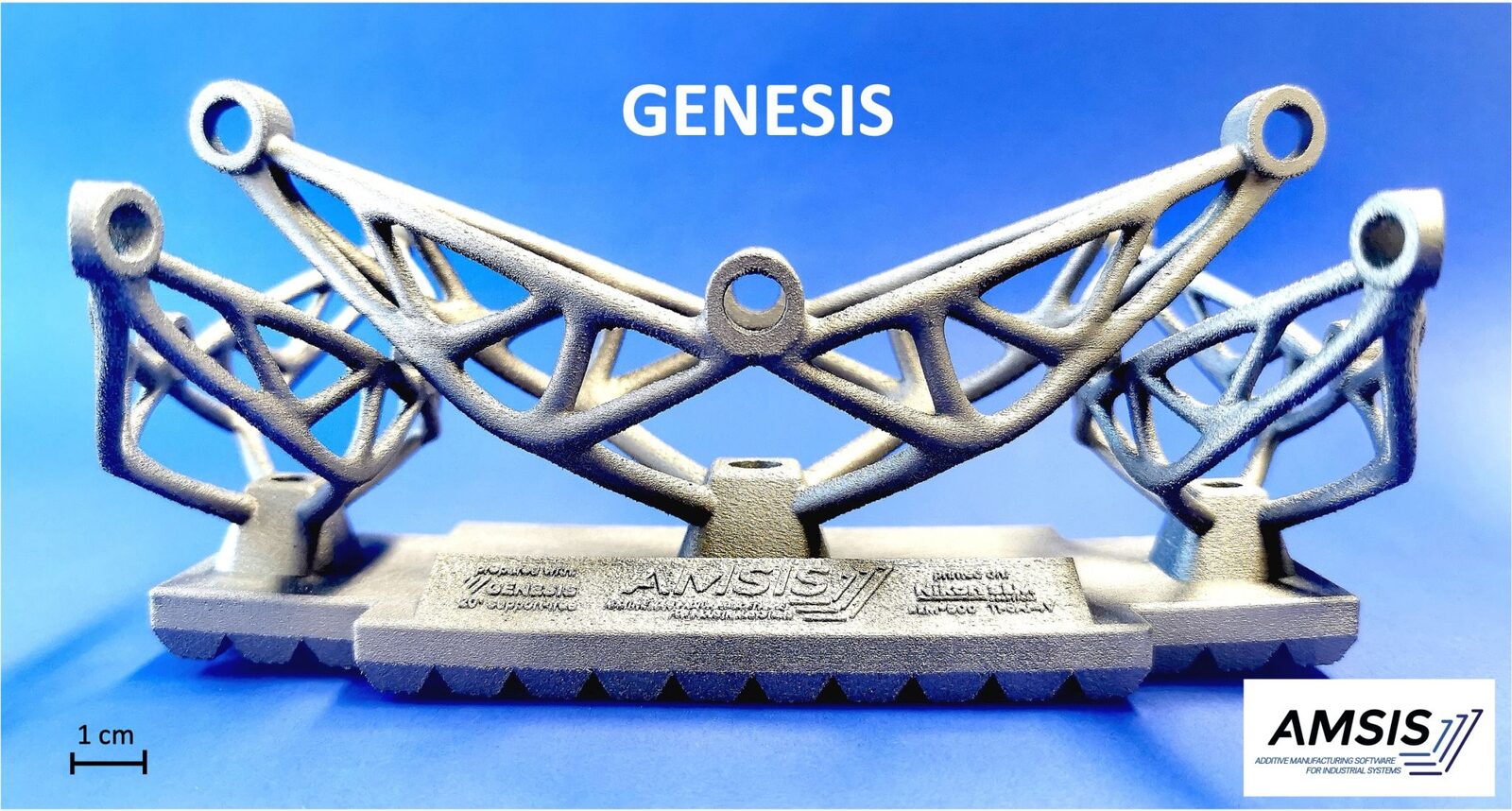
A real serial part, recalculated
One Ti64 aerospace bracket, costed across a full build job — not a projection.
Prepared with standard software
Prepared with GENESIS
Demonstrated overhang angles
20°
Ti64, production machine
0°
on test geometries
−95 %
support volume
Ti64 20° · AlSi10Mg 14° · 316L 20° · IN718 15° · CoCr 20° · M789 25° · AlSi7Mg0.6 25°, from technology evaluations across seven OEM platforms.
The software behind it
What you are trying to solve
Frequently asked questions
How far down does it really go?
On production machines, 20° is demonstrated in Ti64. On test geometries, closed spheres with 0° overhangs were printed entirely without support. The achievable angle depends on material, machine and geometry.
Does it change our process parameters?
No. The approved OEM parameters remain the boundary condition. What changes is how the laser moves, not the parameters it moves with.
What about stem supports?
Self-supporting branches at 25° overhang angles add to this: −52 % support volume, more stiffness against distortion, and room for extra parts underneath.
How quickly do we see a result?
In a pilot on one of your parts. Calibration takes two factors and two build jobs.
Ready to get started?